Filing & search
Inefficient document searches can cost businesses significant time and money.
According to a study by the McKinsey Global Institute, knowledge workers spend nearly 20% of their time searching for and gathering information. That adds up to over an hour and a half of lost productivity every single day.
Fortunately, Zeendoc provides users with an intelligent search engine seamlessly paired with automated document classification. Read on to discover more...
The cost of lost time: smart filing meets intelligent search
Hunting for missing files is a hidden drain on your bottom line. It wastes valuable hours and stalls your team's momentum.
In fact, a landmark study by the McKinsey Global Institute reveals that knowledge workers spend nearly 20% of their workday just searching for and gathering information. That is over an hour and a half of lost productivity every single day, per employee.
Fortunately, Zeendoc changes the game. By pairing an intelligent search engine with automated document classification, it does the heavy lifting for you. Ready to reclaim your workday? Read on to discover how...
AI-powered document indexing
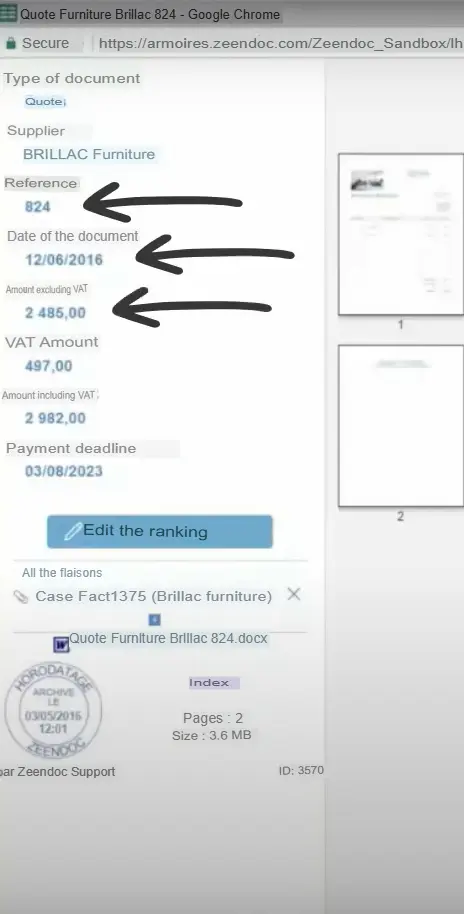
Zeendoc’s built-in AI automatically indexes your expense receipts and supplier documents, instantly capturing the 8 key metadata fields: document type, vendor name, invoice number, invoice date, due date, and all total amounts.
Key Benefits of AI Indexing:
-
Works instantly from the very first document (no training required).
-
Adapts flawlessly to a wide variety of document layouts.
-
95% accuracy rate on data detection.
-
Proprietary solution fully developed and maintained in-house.
-
Secure hosting on our own servers in France.
-
Fully compliant with GDPR and the EU AI Act.
Streamline your document filing with our proprietary Artificial Intelligence model, hosted on our secure French servers. Trained on extensive client and supplier document structures, this new feature boosts your team's efficiency and data accuracy from the exact moment a file is uploaded to Zeendoc!
Corporate file searches: put an end to the daily struggle
1. A Document Labyrinth: Scattered paper files, overloaded hard drives, inaccessible servers, and fragmented cloud storage... Companies accumulate so many storage methods that tracking down one specific file becomes a real challenge.
2. Hidden Treasures: Some documents remain locked away from the rest of the team. Is it due to confidentiality or just an error? Either way, these hidden files cause delays, unnecessary duplicates, and breakdown in communication.
3. Chaotic Filing: Cryptic file names, poorly organized folders, and a total lack of logic... Finding a document in this mess is a major feat. The risk of confusion and mistakes is everywhere, not to mention the hours wasted navigating a chaotic folder structure.
4. Fossilized Information: Outdated documents and forgotten versions... Navigating this graveyard of expired data is not only inefficient, it's also dangerous for decision-making. Oops, did we forget to update the latest financial report?
5. Flying Blind: Vague keywords, tedious manual browsing... Faced with an ocean of documents, relying on old-school methods only leads to frustrating results and lost time.
Finding a document at work shouldn’t feel like an obstacle course. Scattered files, a lack of sharing, poor organization, and outdated information can easily turn a simple lookup into a time-consuming headache.

Fortunately, there is a better way to turn this nightmare into a smooth, seamless search experience. Document Management Systems (DMS) like Zeendoc allow you to centralize, organize, tag, and securely share files, while advanced search features make pinpointing the exact information you need effortless.
Say goodbye to endless searching and growing frustration: choose a modern document workflow and reclaim your valuable time!
The benefits of smarter document retrieval
Say goodbye to dusty archives and endless file searches! Document Management Systems (DMS) revolutionize how businesses handle information, offering a comprehensive solution to optimize document processing, searchability, and security.
1. Centralization: gather all your files in one place
No more documents scattered across physical drawers or personal computers! A DMS centralizes your entire digital inventory into a single system, accessible to all authorized team members. Stop wasting time hunting for the right file everything is just a click away.
2. Organization: Goodbye Chaos, Hello Logic
Say goodbye to messy desktops and unstructured folders. A modern DMS automatically structures your workspace using clear, predictable naming conventions and logical directory trees. Finding your files becomes second nature, keeping your daily workflows clean and frictionless.
3. Automation: Save Your Time and Energy
Let your software handle the heavy lifting! Automated workflows instantly sort, file, and archive documents based on their content or creation date. Built-in AI goes a step further by reading and indexing files automatically, pinpointing key details, and routing them into the right categories.
4. Advanced Search: Find What You Need in a Flash
Document search features go way beyond simple keywords. Combine multiple criteria, use custom filters, and leverage metadata to track down the exact file you need. Full-text search, phonetic search, and proximity search ensure ultra-relevant results every time, while smart semantic algorithms grasp the true meaning behind your queries to serve up the perfect match.
5. Accountability: A Clear Owner for Every Document
With a collaborative system, every document is tied to a clear, identifiable owner. No more guessing who to contact for an update or clarification! Team members can easily filter their searches to display files managed by a specific colleague, keeping operations smooth and transparent.
6. Security: Safeguard Your Valuable Data
Protect your sensitive information with robust, built-in security features. Define precise user roles and restrict document access based on employee profiles. Sleep easy knowing your corporate data is in safe hands.
Technologies powering modern document retrieval
In the digital age, businesses are shifting to modern solutions to manage information. Digitization has become the standard approach for optimizing data management across organizations.
Say goodbye to mountains of paper! Moving to a paperless environment significantly reduces physical storage needs, freeing up space and making information easier to access.
But how do you navigate that vast ocean of digital files? Fortunately, several technical solutions exist to simplify data processing and retrieval:
-
1. Optical Character Recognition (OCR): Bringing Paper to Life OCR technology converts physical documents into searchable digital files. By recognizing printed or handwritten text, information trapped on paper becomes accessible and actionable.
-
2. Databases: Structured and Secure Archiving Database Management Systems (DBMS) provide a structured foundation for storing and managing digital documents. They centralize data, ensure security, and streamline retrieval through advanced features.
-
3. Indexing and Metadata: Instant Sorting Indexing and assigning metadata to digital files are essential for optimizing searchability. Using tags, keywords, and descriptive data makes classifying and locating relevant documents nearly instantaneous.
-
4. Document Management Systems (DMS): The All-in-One Solution A Document Management System (DMS) is the ultimate approach to digitization. DMS solutions combine the power of databases with advanced technologies like OCR, indexing, and metadata to deliver a centralized, secure, and highly efficient document management framework.
By embracing digitization and DMS solutions, companies gain valuable time, productivity, and efficiency in how they manage their most critical information.

ICR: INTELLIGENT character recognition
ICR (Intelligent Character Recognition) is an advanced form of OCR technology that reads not only printed text, but also handwritten characters. Driven by Machine Learning algorithms, it "learns" from every document it processes to accurately interpret handwriting over time.
Powered by ABBYY Vantage technology, Zeendoc upgrades its capabilities to seamlessly recognize documents containing handwriting.

Common Use Cases: Expense receipts, delivery slips, signed work orders, logs, official forms, and consultation notes.
Key Benefits of Zeendoc's Built-In ICR:
-
Enhanced automation across all document types.
-
Valuable time savings in indexing and filing.
-
Fully integrated into Zeendoc at no extra cost.
-
Drastic reduction in data entry and transcription errors.
-
A continuously evolving, cutting-edge document solution.
How document search works

Searching in Zeendoc is easy, using a single search bar located at the top of the interface. Simply type one or more keywords into the search bar, and Zeendoc will instantly return a list of relevant files.
Zeendoc ranks your search results based on a variety of key factors, including:
-
Document Content: The keywords you enter are matched against the document's actual contents, including the file name, the full text of the document, and its metadata tags.
-
Document Properties: You can also look up files based on specific attributes, such as their creation date, file type, or owner.
-
Document Location: You can choose to search within specific folders or scan your entire Zeendoc repository.
Automated document recognition & data capture (RAD/LAD)
Automated Document Recognition (RAD), Automated Data Capture (LAD), and OCR (Optical Character Recognition) are complementary technologies that play a crucial role in modern document management. Zeendoc leverages these technologies to optimize your document workflows by automating the capture and processing of information from paper documents.
In practice, this allows businesses to save time, cut costs, improve file organization and accessibility, and stay fully compliant with industry regulations.
How OCR empowers document capture and processing (RAD/LAD)
OCR operates at the very front end of the data capture workflow, transforming paper documents into actionable digital files. This essential step allows you to:
-
Automate Data Capture: OCR eliminates tedious manual data entry, cutting costs and reducing the risk of errors.
-
Improve Data Quality: Automated character recognition ensures higher accuracy and reliability for all extracted data.
-
Simplify Indexing and Search: Digital text generated by OCR makes indexing and searching files effortless, streamlining access to your information.
Real-world OCR use cases with Zeendoc
Optical Character Recognition (OCR) is a powerful technology with countless applications in document management. Here is how Zeendoc’s OCR can transform your daily operations:
1. Digitizing historical archives
Companies with legacy paper archives can leverage OCR to scan and index historical records, unlocking two major benefits:
-
Easy Access: Turn years of paper archives into a fully searchable database. Whether dealing with financial statements, annual reports, or HR files, OCR makes every single word accessible.
-
Optimized Storage Space: By digitizing your archives, you drastically reduce the physical footprint needed for file storage while ensuring long-term data preservation.
2. Invoice management
Managing incoming bills efficiently is a major corporate hurdle. With Zeendoc’s OCR, every scanned or PDF invoice is automatically analyzed to extract key data points, such as totals, vendor names, and due dates.
-
Automated Processing: Extracted data syncs directly with your accounting software, eliminating manual typos and speeding up payment cycles.
-
Quick Lookup: Every invoice becomes instantly searchable via simple keywords whether you search by vendor name, invoice number, or a specific date.
3. Contract archiving
Contracts contain critical information that must remain secure yet easily accessible. Thanks to OCR, Zeendoc enables:
-
Automated Indexing: Key contract terms such as party names, signature dates, or specific clauses are indexed automatically.
-
Streamlined Review: Pinpoint a contract in seconds by searching for a specific term or milestone clause, a lifesaver during audits or renewals.
-
Deadline Tracking: By combining OCR with Zeendoc’s core features, you can set up automated alerts for critical milestones like contract renewals, ensuring you never miss a deadline.
4. Incoming mail management
Efficiently process all business correspondence, whether physical or digital, using Zeendoc’s OCR:
-
Automated Routing: Scanned mail is instantly analyzed, key information is extracted, and documents are automatically routed to the correct person or department.
-
Tracking & Accountability: Every piece of mail is indexed and securely stored, making it easy to track responses and pending actions.

The benefits of automated document recognition & data capture (RAD/LAD)
Integrated into Zeendoc’s automated document processing solution, OCR delivers powerful advantages for your business:
1. Save Time and Cut Costs Automating data entry with OCR saves small and medium-sized businesses (SMBs) valuable hours on tedious manual tasks, such as processing invoices, purchase orders, or administrative forms. This frees up your team to focus on high-value activities like business development and client relationships. Additionally, OCR reduces the need for dedicated data entry staff, translating into significant cost savings.
2. Better Organization and Effortless File Searches OCR allows SMBs to easily classify and locate digital files through automated indexing and keyword search. This puts an end to frustrating hunts through physical archives and ensures that critical information is always at your fingertips. This improved file organization leads to faster, data-driven decision-making and seamless team collaboration.
3. Enhanced Accessibility and Regulatory Compliance OCR makes digitized files accessible to visually impaired team members using assistive technologies, such as text-to-speech software. Furthermore, secure cloud archiving helps SMBs easily comply with legal and statutory document retention requirements.
In short, OCR provides SMBs with an invaluable set of benefits to save time, reduce overhead, streamline file organization, and maintain compliance. If you are looking for an effective solution to optimize your document workflows, OCR is a technology you can't afford to overlook.
Digitizing historical archives
Companies with legacy paper archives can leverage OCR to scan and index historical records, unlocking two major benefits:
-
Easy Access: Turn years of paper archives into a fully searchable database. Whether dealing with financial statements, annual reports, or HR files, OCR makes every single word accessible.
-
Optimized Storage Space: By digitizing your archives, you drastically reduce the physical footprint needed for file storage while ensuring long-term data preservation.
The benefits of automated document recognition & data capture (RAD/LAD)
Integrated into Zeendoc’s automated document processing solution, OCR delivers powerful advantages for your business:
1. Save Time and Cut Costs Automating data entry with OCR saves small and medium-sized businesses (SMBs) valuable hours on tedious manual tasks, such as processing invoices, purchase orders, or administrative forms. This frees up your team to focus on high-value activities like business development and client relationships. Additionally, OCR reduces the need for dedicated data entry staff, translating into significant cost savings.
2. Better Organization and Effortless File Searches OCR allows SMBs to easily classify and locate digital files through automated indexing and keyword search. This puts an end to frustrating hunts through physical archives and ensures that critical information is always at your fingertips. This improved file organization leads to faster, data-driven decision-making and seamless team collaboration.
3. Enhanced Accessibility and Regulatory Compliance OCR makes digitized files accessible to visually impaired team members using assistive technologies, such as text-to-speech software. Furthermore, secure cloud archiving helps SMBs easily comply with legal and statutory document retention requirements.
In short, OCR provides SMBs with an invaluable set of benefits to save time, reduce overhead, streamline file organization, and maintain compliance. If you are looking for an effective solution to optimize your document workflows, OCR is a technology you can't afford to overlook.
Unlock the full potential of your business data!
Benefit from the power of Zeendoc, the leading DMS solution for SMBs.